Resource Category 🟢-2 Playbooks

How trust companies can deliver transaction-level investment accounting on every client portfolio

transaction-level-cover-@2x
Resource Category 🟢-2

Playbooks

for trustees

Trust companies are expected to keep accurate, reconcilable, audit-ready accounting records for every investment portfolio they administer. Clients increasingly expect more than that: transaction-level, double-entry investment accounting delivered each quarter, on par with the records a private bank or wealth manager produces for its own books. Most trust companies struggle to deliver it.

This playbook sets out the five operating principles a trust company needs in place to close that gap, and explains why a quarterly cadence aligned to the investment counterparty’s primary book of record is a more reliable basis for accounting than the daily frequency offered by some platforms.

Why trust companies can’t afford to wait

Person 🟢
Client expectations

Clients want digital, transaction-level visibility of their administered wealth, on par with a private bank.

Money Off 🟢
Margin pressure

Manual bookkeeping is expensive, slow and ties up skilled trust company staff on low-value work.

Policy 🟢
Audit scrutiny

Auditors and regulators treat the absence of a clean reconciliation to the counterparty’s audited statements as a control weakness.

The five-step playbook

The five operating principles below describe how to deliver transaction-level investment accounting at trust company scale.

01 Recognise

The bookkeeping gap most trust companies face

“Accounting is the language of business.”

— Warren Buffett

Most trust companies cannot, today, produce transaction-level double-entry investment accounting on every portfolio they administer. Counterparty statements arrive in different formats and at different frequencies. Illiquid positions are valued on different timelines. The connections between admin systems and accounting ledgers are imperfect. The result is a patchwork of manual entry, spreadsheet bridges and quarterly reconciliations that never fully reconcile.

Closing the gap requires a single, trusted source of investment data covering every holding, every transaction and every accrual, in one consistent schema, refreshed each quarter for every client.

02 Source

Data direct from the investment counterparties

“In God we trust. All others must bring data.”

— W. Edwards Deming

The data underpinning your investment accounting service should be sourced directly from the counterparties holding the assets: the custodian banks, private banks, investment managers and fund administrators. Data that arrives through a staff member, a manual upload or a re-keying step has already lost integrity before it reaches your ledger.

On arrival, it should be independently verified against the counterparty’s reference data and pricing, with holdings reconciled, transactions matched and discrepancies flagged for investigation before anything is released into your ledger.

transaction-level-verification-@2x
03 Validate

Why quarterly processing is the right frequency

“Proper accounting is like engineering. You need a margin of safety.”

— Charlie Munger

Receiving data daily is not the same as processing it daily. The investment counterparty’s primary book of record is finalised at quarter end, not daily. The closer your accounting records sit to that book of record, the more reliable the reconciliation. Five reasons why:

Source of delay Why it happens Why it matters for accounting
Repricing of illiquid securities Less liquid holdings, such as funds-of-funds, structured products, private credit, hedge funds and private equity, are priced after period end once the counterparty has received underlying valuations and applied its own price tolerance and committee review. Daily prices feeding your ledger before the counterparty has finalised its valuation will not reconcile to the audited valuation that follows.
Backdated corporate action postings Dividends, scrip issues, capital returns, splits, mergers and tender offers are often booked by the counterparty several days or weeks after the ex-date once entitlements and elections have been verified. A transaction posted to your ledger on the wrong effective date corrupts the income/capital character of the holding and, where situs or domicile filters apply, the tax position.
Dividend equalisation Funds that issue new units between distribution dates split the period's income between true distribution and return of capital. The split is calculated by the fund administrator after the distribution date. Without the equalisation adjustment, a fund distribution recorded daily will overstate income and understate capital. That is a beneficiary-level reporting error. 
Late trade settlement and amendments Trade dates, settlement dates and contract amendments, particularly across time zones, holidays and complex instruments, are routinely corrected by the counterparty in the days following execution. Provisional postings released into your ledger before the counterparty's correction window closes generate reconciliation breaks and audit findings. 
Fees, accruals and rebates Management fees, performance fees, retrocession rebates and accrued income are calculated and posted by the counterparty on a periodic cycle, often at quarter end. Accrued figures recorded daily on your side will differ from the audited statement and require manual rework at every audit.

Five reasons investment counterparties finalise their primary book of record at period end.

Quarterly is also the natural cadence of trustee governance. Investment Committees meet quarterly. Monitor reviews are typically delivered quarterly. Trust accounts are prepared and audited annually against quarter-end positions. Aligning the bookkeeping frequency to that rhythm is the design principle.

04 Standardise

Universal double-entry, in any accounting system

“If you can’t explain it simply, you don’t understand it well enough.”

— Albert Einstein

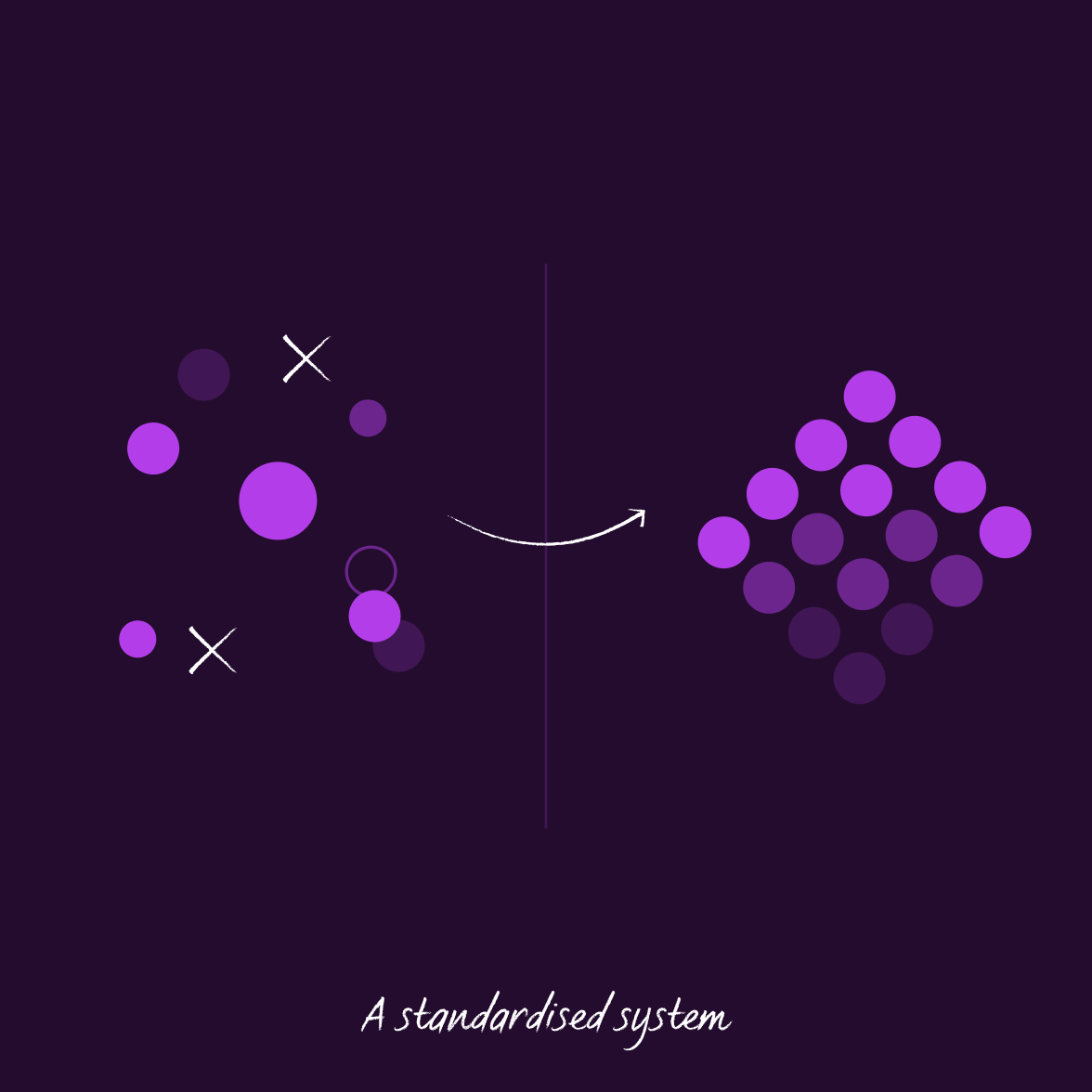
Validated counterparty data is only useful once it has been mapped to a universal, transaction-level, double-entry bookkeeping standard any trust admin or accounting system can consume. The schema should carry trade and settlement dates, security identifiers, transaction types, gross and net amounts, currency, FX rate, income and capital character, fees and accruals, alongside aggregate holdings valuations and classifications.

Done this way, the full transaction history of every portfolio can be posted in the same format, on the same quarterly cycle, for every client.

transaction-level-standardise-@2x
05 Automate

Straight through into your admin and accounting systems

“What gets measured gets managed.”

— Peter Drucker

Validated, standardised data is only useful when it lands inside the system you use day-to-day. Two routes should be available: pre-built integrations into the leading admin and accounting systems for faster deployment, and an open API for bespoke integration where deeper customisation is needed.

A single structured data request from a well-designed API can save roughly 40 minutes of manual work per portfolio, per quarter. For a trust company monitoring 500 portfolios at a blended staff cost of £1 per minute, that is £80,000 a year in saved time, before reduced error rates and the redeployment of trust company staff onto higher-margin work.

How Connect turns the framework into reality

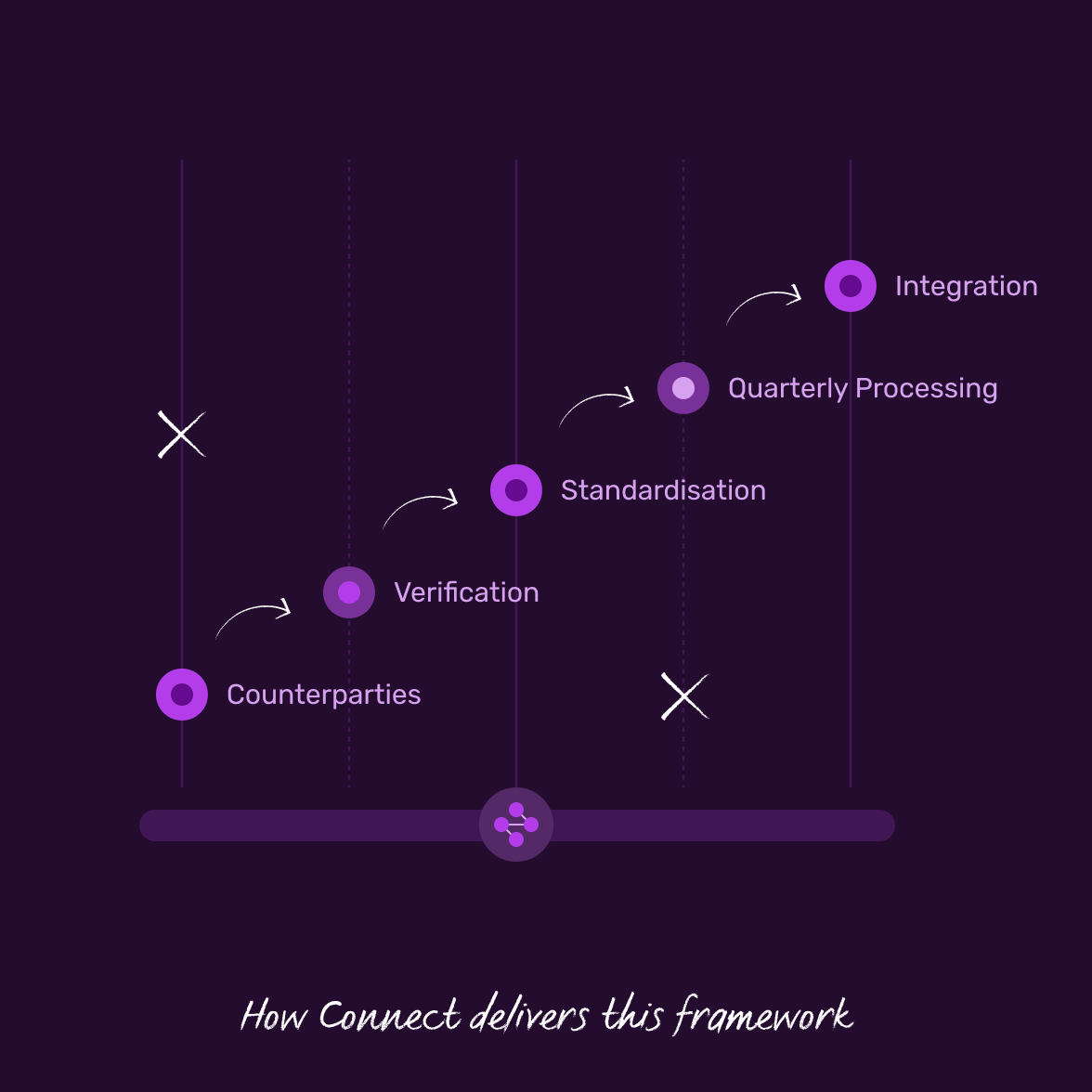
Enhance’s Connect platform is purpose-built to deliver the five-step framework above.

Data is received directly from the counterparties holding the assets, independently verified on arrival and mapped to a universal double-entry standard. Connect receives data daily but processes it on a quarterly cycle aligned to the counterparty’s primary book of record. Pre-built integrations cover PlainSail, Quantios, Ambitium, Vega Technology and Opitifi; the Connect API supports bespoke integrations with BDO Jersey, Continuum, CorefocusX, ResolutionIT and QBIX. Connect is provided at no additional cost as part of the Enhance Monitor service.

transaction-level-connect-framework-@2x
$50bn

Assets under reporting

£5bn

Assets under advice

7,000+

Connect accounts

800+

Investment managers

300+

Investment feeds

25,000+

Investment securities

The bottom line

Transaction-level double-entry investment accounting on every client portfolio, reconciled to the counterparty’s primary book of record each quarter, is a service few trust companies currently offer. The five-step framework above is the operating model. Connect is one way of putting it into production. If Enhance already monitors your portfolios, the Connect bookkeeping data is yours at no additional cost.

Connect Data Playbook_Automating Trust Bookkeeping_15.06
Resource Category 🟢-2

Playbooks

for trustees

Download this Connect Playbook for trustees.

connect-factsheet-cta-mobile-cropped

News, Peer Groups and Market Data

Sign-up for the latest news and insights from Enhance, delivered direct to your inbox.

Icon x 4 🟢