Resource Category 🟢-2 Playbooks

Manager selection: a research process for trustees to follow

For trustees

The 5P framework behind every manager a trustee is recommended.

manager-selection-5p-process-cover@2x
Resource Category 🟢-2

Playbooks

for trustees

This playbook is a plain-English guide for trustees. It sets out a five-pillar research process for evaluating investment managers, so that a trustee’s eventual decision rests on comparable, evidenced findings rather than on relative impressions formed in a meeting. The same framework should hold up just as well when a fund is reconsidered years later as it did on the day it was first approved.

Trustees are rarely equipped to independently assess a fund manager’s process, team stability or embedded costs to the same depth a dedicated research function can. Yet the decision of which managers sit in a portfolio is one of the most consequential a trustee makes. It is tested for years afterwards, against the standard of what a prudent trustee ought reasonably to have known at the time.

A structured, repeatable research framework closes that gap. It applies the same criteria, in the same order, with the same evidence requirements, to every manager under consideration, whether the strategy is active, passive or alternative. It also re-tests managers already approved, rather than treating approval as a one-off event. This playbook sets out the five pillars such a framework should cover, and how each is tested in practice.

The manager being tested might run a fund a trustee is considering for a platform-based portfolio, or a segregated mandate appointed to manage assets directly. The five pillars apply to either. A trustee selecting or retaining a manager without an equivalent evidenced process carries the same duty exposure whichever structure is used.

reviews@2x
Manager claims

Every investment manager a trustee meets will describe its own track record, process and people favourably.

groups@2x
Style and team drift

A manager that tested well two years ago can be different today if its process, ownership or people have changed.

money-bag@2x
Fee drag

A small, persistent difference in fees compounds materially over a multi-decade investment horizon.

A research process a trustee cannot examine is a research process a trustee cannot rely on.

01 Performance

Test the track record against the right comparators, not just its own history

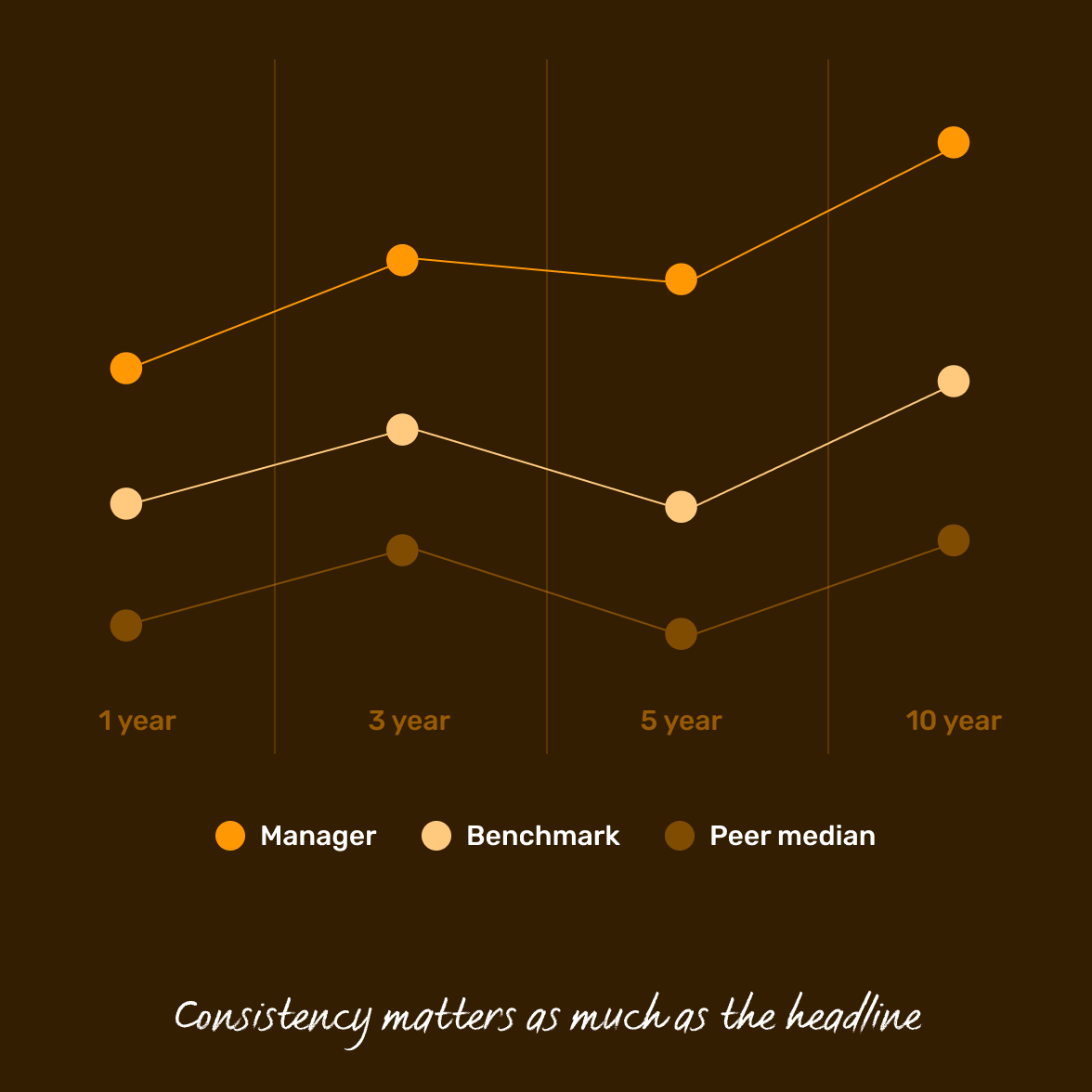
Past performance is not a reliable indicator of future results, but it is the most testable assertion any manager makes. Risk-adjusted returns should be evaluated against the relevant benchmark and against a peer group of genuinely comparable managers, over multiple time horizons rather than a single favourable period. Drawdown profiles deserve particular attention: how a manager behaved in a market dislocation says more about its risk management than how it behaved in a rising market.

Consistency matters as much as the headline number. A long-run track record built on a small number of exceptional years is a different proposition from one that has compounded steadily, even where the average annual return looks similar. Where possible, this pillar should be anchored in real client outcomes, not survey statistics supplied by the manager itself.

manager-selection-5p-process-consistency@2x
02 Process

Establish whether returns were earned by a repeatable method, or by chance

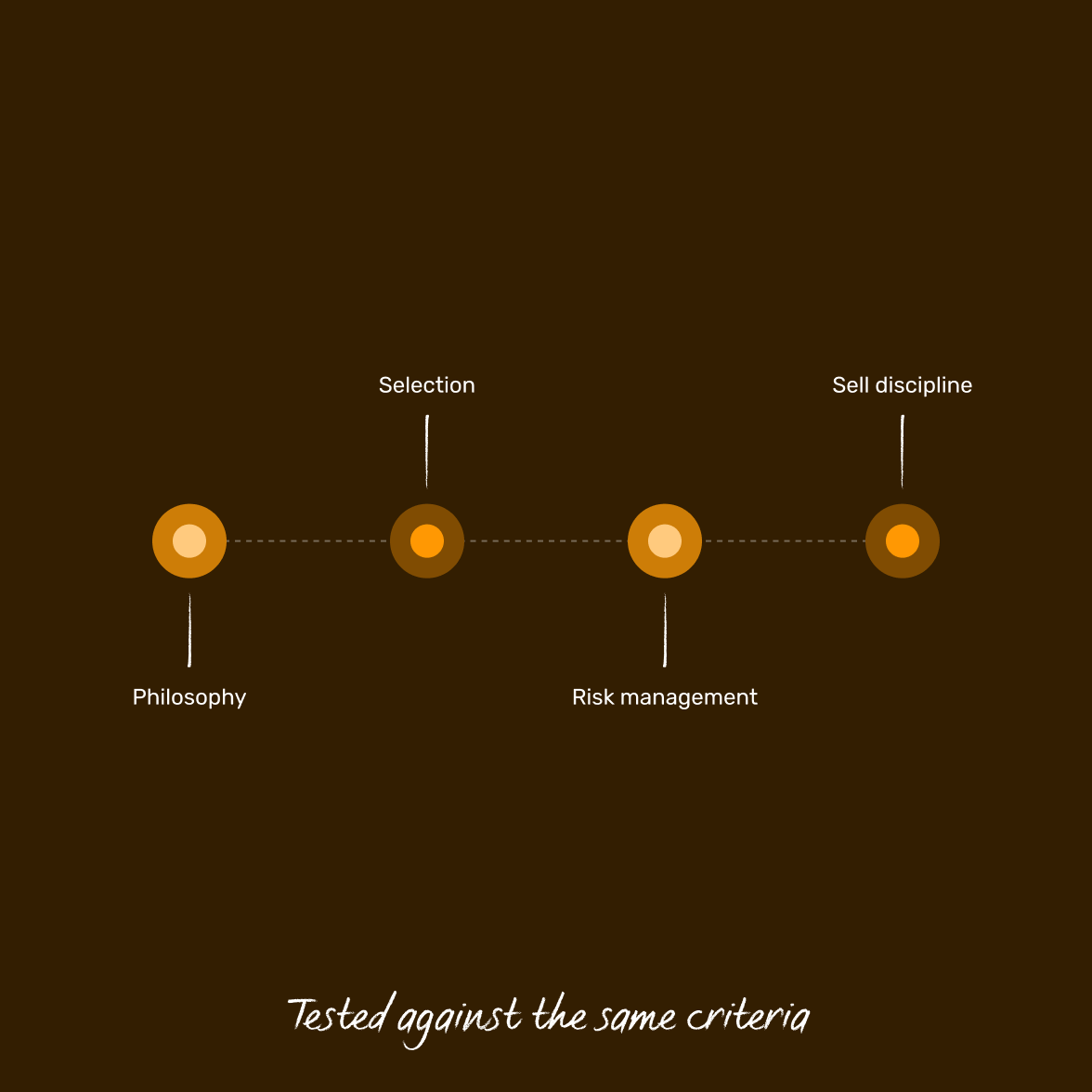
This is the most difficult pillar to assess and the most important. A strong track record produced by a sound, repeatable process is one proposition; the same track record produced by a single successful style bet, or by chance, is quite another. Testing this pillar means probing the manager’s investment philosophy, security selection methodology, risk management framework and sell discipline. It also means asking whether what worked in the past has the durability to keep working as conditions change.

The questions should be adapted to the type of strategy. Active managers are best tested on stock-selection discipline. Passive vehicles are best tested on tracking accuracy and how securities-lending revenue is treated. Alternative strategies are best tested on how idiosyncratic risk is identified and managed.

manager-selection-5p-process-tested-against-the-same-criteria@2x
03 People

Test the team behind the process, and re-test whenever it changes

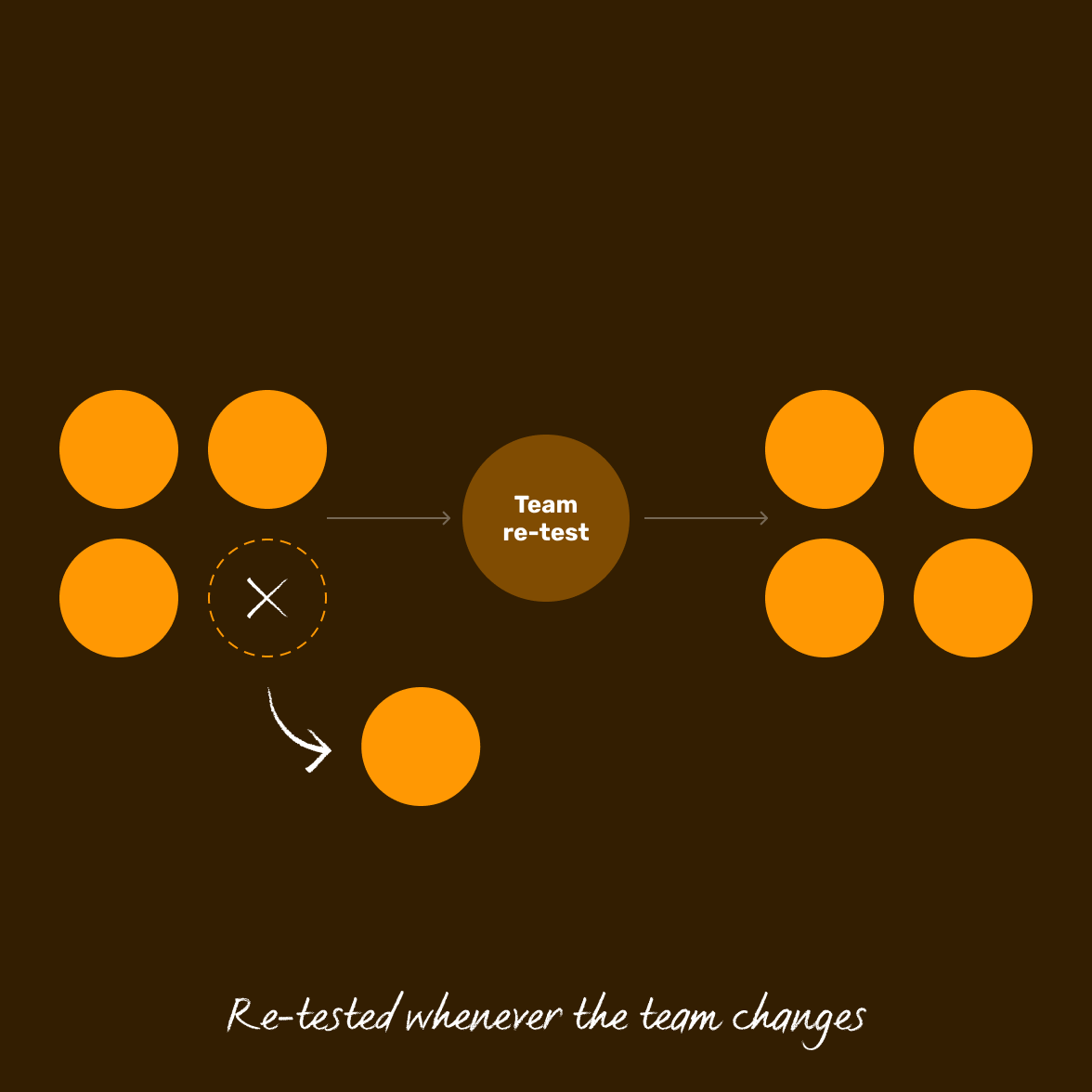
A process is only as durable as the team executing it. This pillar tests the experience, incentive alignment, diversity of perspective and stability of the people actually managing the money, not the manager’s brand. A manager that has lost a key decision-maker is, in effect, a different manager, even where the name on the door is unchanged. A process that tested well only months earlier can unravel once the people behind it change.

This is the pillar most likely to need re-testing outside a scheduled cycle. A meaningful change of lead manager, a change of ownership at the manager, or the departure of key personnel should trigger an immediate re-review rather than waiting for the next scheduled interval.

manager-selection-5p-process-re-tested-whenever-the-team-changes@2x
04 Price

Test the fee against the peer-group median, and look for costs the headline number hides

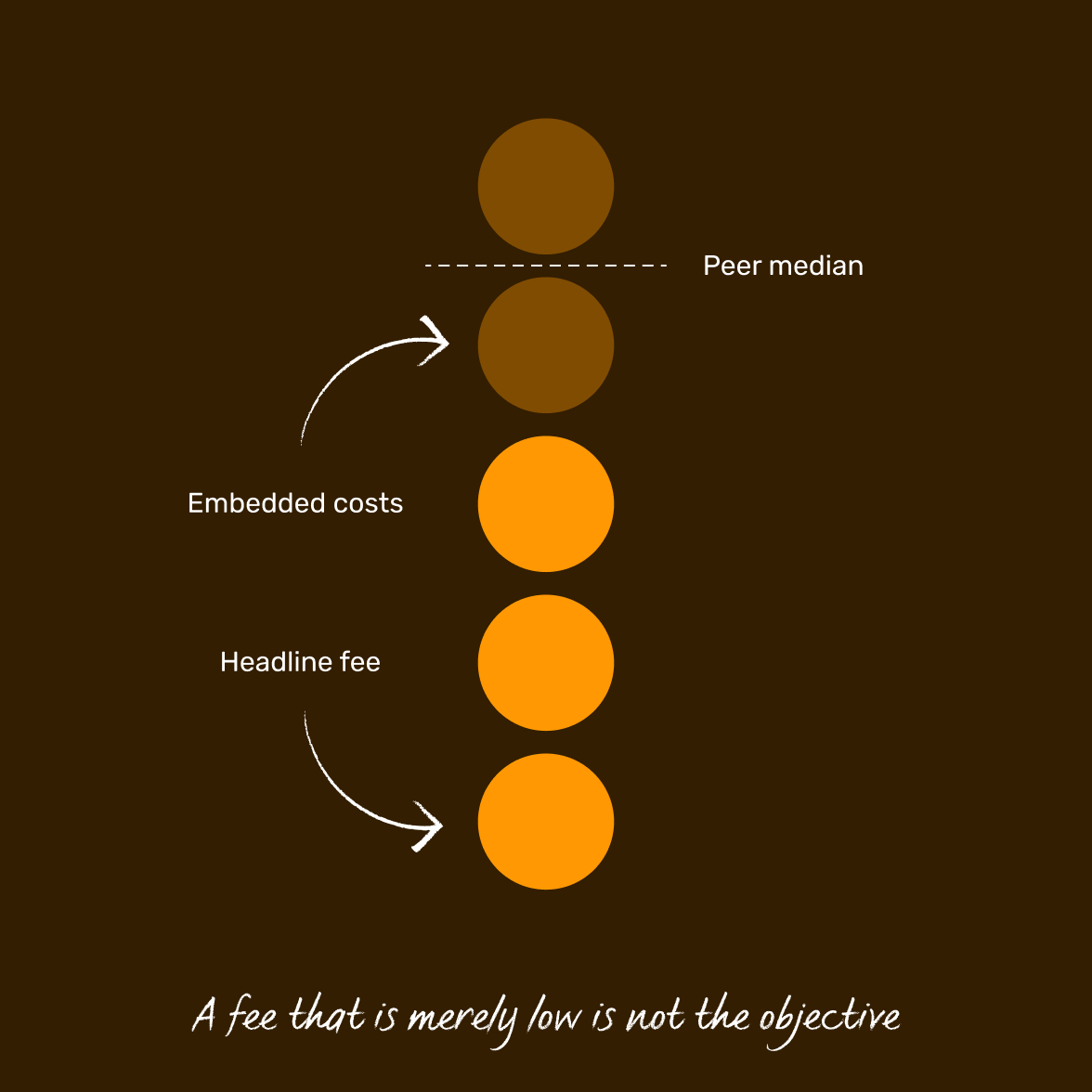
Fees compound. A manager charging half a percentage point more than its peers, with no compensating value, costs an investor materially over a multi-decade horizon. This pillar tests a manager’s headline fee against its peer-group median. It then examines the embedded costs a headline fee can mask: transaction costs, performance-fee structures, and, for pooled vehicles, how securities-lending revenue is treated and shared.

Where a trustee’s assets, or a consultant’s aggregated client assets, give genuine negotiating scale with a manager, that scale should be used. It can secure more competitive terms, provided the manager remains appropriately incentivised to deliver. A fee that is merely low is not the objective; a fee that is justified by what it buys is.

manager-selection-5p-process-hidden-fees@2x
05 Planet

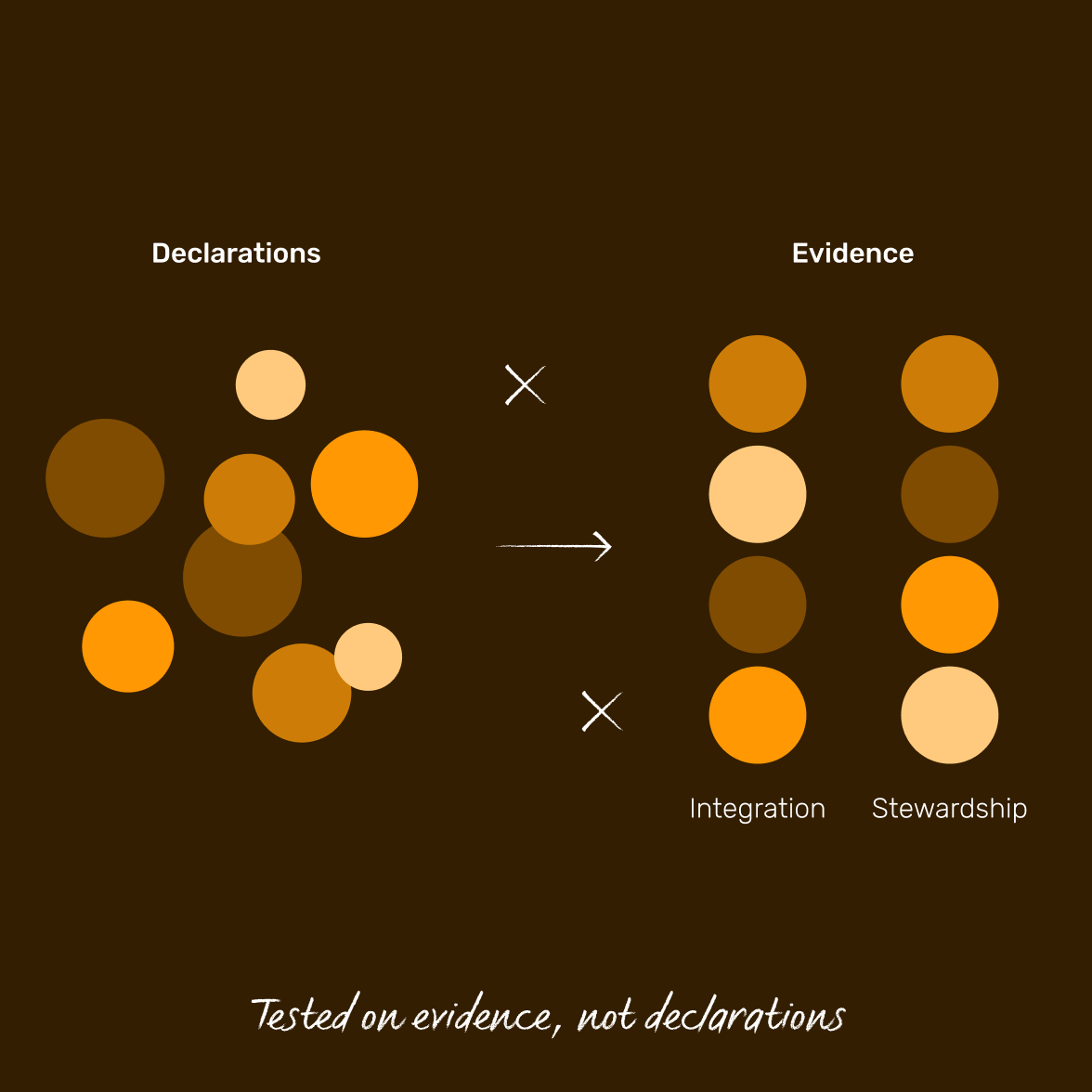
Test for evidence of ESG integration, not for a manager’s own declarations

This pillar tests for evidence rather than declarations. It examines how a manager identifies and assesses environmental, social and governance factors, and how those factors influence security selection in practice. It also examines what stewardship activity the manager undertakes, including voting record and engagement with investee companies. The pillar applies regardless of whether a manager markets itself as ESG-focused: one that never mentions ESG is tested on the same evidence as one that leads with it.

manager-selection-5p-process-tested-on-evidence@2x

How the five pillars become a portfolio

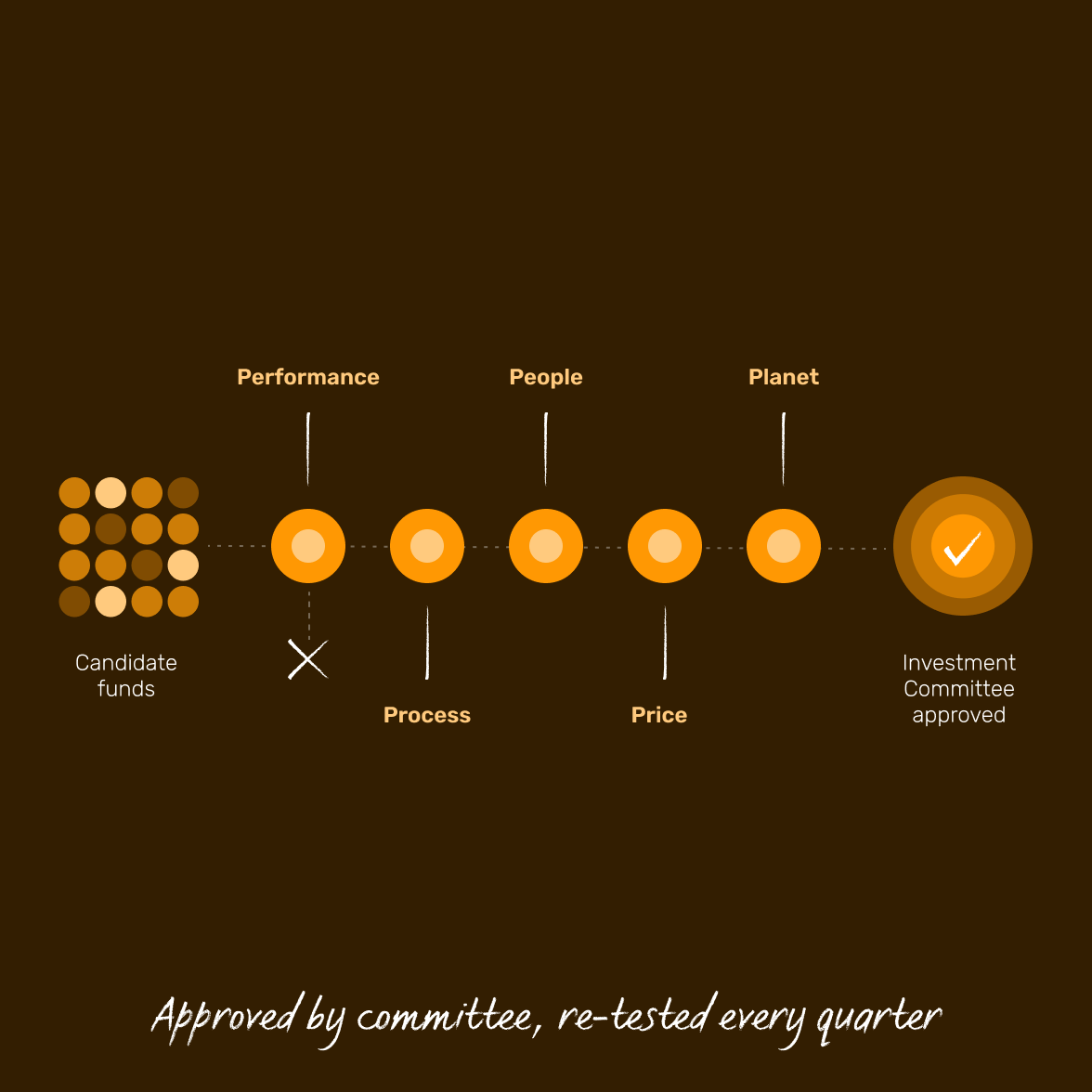
A structured research framework is only useful if its output is bounded and its findings are current. In the Enhance model, this framework is called 5P. Its output is an Investment Committee-approved fund universe: the curated set of funds an Investment Consultant can select from when building a client’s portfolio. The pillars are applied in order, so a fund that fails on Performance is not carried through the remaining four.

5P research is conducted by a team of CFA and CISI-accredited Research Analysts, working to a standard template applied consistently across every fund considered. It is strengthened by data from the more than 7,000 portfolios Enhance monitors for trustees globally. That data anchors the Performance pillar in real client outcomes, rather than survey statistics supplied by managers themselves.

Funds are not approved indefinitely. The Investment Committee considers 5P findings and re-testing outcomes at every quarterly cycle, adding funds that newly pass the framework and removing funds that no longer do. Ad hoc re-review is triggered immediately by any meaningful change at a manager, rather than waiting for the next scheduled cycle. That includes a change of lead portfolio manager, a change of ownership, or a material breach of a fund’s stated mandate.

Every 5P finding is documented against the standard template, not summarised from memory at the Investment Committee meeting. That record gives trustees, and their auditors and regulators, a dated account of why a fund was approved, why it was retained at each subsequent review, and why a fund was ever removed. A research process that cannot produce that record on request is, in practice, no more evidenced than a consultant’s word.

The 5P process at a glance  
Portfolios behind the Performance data 7,000+
Investment managers researched 800+
Research review cycle Quarterly, plus ad hoc triggers
Approval body Independently chaired Investment Committee

Trustees never need to ask whether the funds in a Select portfolio still meet the standard that got them approved. The Investment Committee has already asked the question, on a recurring basis, and the answer is documented rather than assumed.

Select’s own approved universe is built from funds implemented on the platform. Where a trustee holds, or is considering, a segregated mandate with a manager elsewhere, Connect gives the Investment Consultant visibility of it too. The same 5P discipline can then be applied in an advisory capacity, even though the manager sits outside the platform.

The same test applies to any manager research process a trustee is asked to rely on, whether it belongs to Enhance or another consultant, and whether the manager runs a fund or a segregated mandate. A framework that cannot show its criteria, its cadence and its evidence is working on reputation rather than proof. A trustee who cannot see the framework cannot evidence that the underlying duty to take proper advice has been discharged.

manager-selection-5p-process-approved-by-committee@2x
Enhance_Playbook_Select_Manager_Selection_5P_Process-small
Resource Category 🟢-2

Playbooks

for trustees

Download this Select Playbook for trustees.

select-factsheet-cta-mobile

News, Peer Groups and Market Data

Sign-up for the latest news and insights from Enhance, delivered direct to your inbox.

Icon x 4 🟢