Resource Category 🟢-2 Playbooks

Building an Investment Committee for a trust company that discharges its investment duties

For trustees
trustee-committee-cover-@2x
Resource Category 🟢-2

Playbooks

for trustees

This playbook is a practical guide for trust company directors, risk and compliance teams on how to establish an Investment Committee that discharges the trust company’s fiduciary investment duties. It walks through the committee’s composition, terms of reference and meeting cadence, the policy documents that underpin it, the monitoring it should run on, and the independent investment voice that turns a recurring meeting into a governance forum.

Every regulated trust company operates under a supervisory framework that requires demonstrable board-level oversight, documented risk management and evidenced periodic review of the services it provides to clients. Most regulated trust companies already have an Investment Committee. Fewer have one that would survive close scrutiny from a regulator, a beneficiary or a successor trustee. The difference between a committee that discharges the duty and a committee that ratifies decisions already taken is not the seniority of the people in the room. It is the structure of the committee, the quality of the information in front of it, the independence of the investment voice contributing to it, and the audit trail it leaves behind. This playbook covers all four, set out as five steps and mapped to the four trustee investment duties identified in our companion playbook on trustee investment responsibilities.

Why most trust company Investment Committees fall short

Three weaknesses recur across the trust company sector.

Draft 🟢
A charter problem

The committee operates without a documented purpose, scope or authority, and decisions cannot be cleanly traced back to it.

Group 🟢
A composition problem

The wrong people are in the room, or the right people are missing, and the committee’s deliberations run on a single perspective.

Table 🟢
A content problem

The committee runs on anecdotal updates, manager-supplied performance summaries and one-off spreadsheets rather than independently verified, practice-wide management information.

Each weakness exposes the trust company to its regulator. Across the leading trust jurisdictions, the wording of the rules differs but the substance converges: an effective corporate governance system overseen at board level, documented risks and controls, accurate information systems, and robust periodic review of the services provided to clients. An Investment Committee is the natural forum through which a trust company demonstrates that framework in operation. The five steps that follow walk through how to build one that does.

The five-step playbook

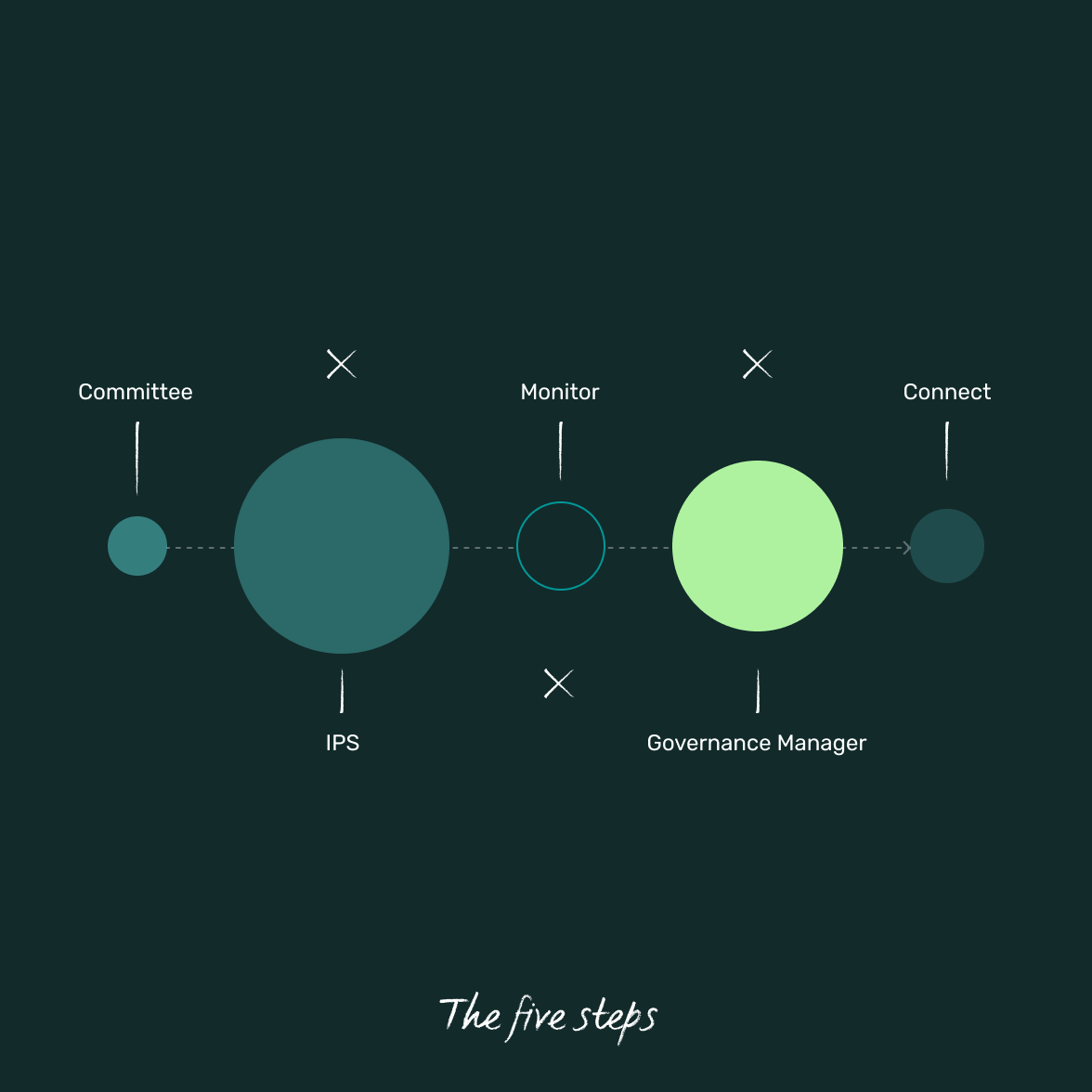
The five steps are intended to be read in order. Each depends on the one before. They are written for the trust company board and the directors, risk officers and senior trustees responsible for the firm’s investment governance framework.

trustee-committee-five-steps-@2x
01

Establish the committee

The committee starts with three deliverables: a documented terms of reference, the right composition, and a meeting cadence that matches the monitoring cycle that feeds it. The terms of reference set out the committee’s purpose, authority, scope, membership, quorum, meeting frequency and reporting line into the trust company board. Each meeting should run to a standing agenda with management information tabled in advance, be properly minuted, and produce a formal action log carried forward to the next meeting. Decisions that cannot be evidenced are decisions that did not happen, and the terms of reference are the document a regulator, an auditor or a successor trustee will ask to see first.

The recommended composition is eight to ten seats drawn from compliance, legal, operations, the firm’s investment gatekeeper, two client-facing trustees, a chair (typically a board director), and the independent investment voice covered in Step 04. The principle is to assemble the breadth of perspective needed to oversee investment activity across the trust company’s book, with clear separation between the committee’s role in oversight and the individual trustees’ role in decision-making for the trusts they administer.

Quarterly is the right meeting cadence, aligned to the natural data cycle of investment managers and custodians. Quarterly minutes accumulate over time into a documented governance record across every client the committee is responsible for, and quarterly action logs give the committee a continuous record of what it has identified, what it has decided and when it has resolved.

02

Standardise an Investment Policy Statement for every client

An Investment Policy Statement is the document against which every portfolio is monitored and every investment manager is held to account. It sets out the return objectives, risk parameters, holdings constraints and tax considerations that govern how a portfolio is to be managed, and translates into the mandate compliance checks an independent monitoring service runs every quarter. A trustee operating without an IPS for every client portfolio has no documented framework against which to evaluate the manager, and limited defence if challenged.

What matters at the committee level is consistency. The same IPS framework, applied to every client portfolio in the same structure, lets the committee review every trust portfolio through one compliance lens and identify the outliers. It also lets new clients be onboarded without rebuilding the policy architecture from scratch. A trust company running one IPS structure across its book has a single comparable view of every client; a trust company running a hundred different structures has no comparable view at all.

03

Operate multi-tier monitoring at portfolio, client and practice level

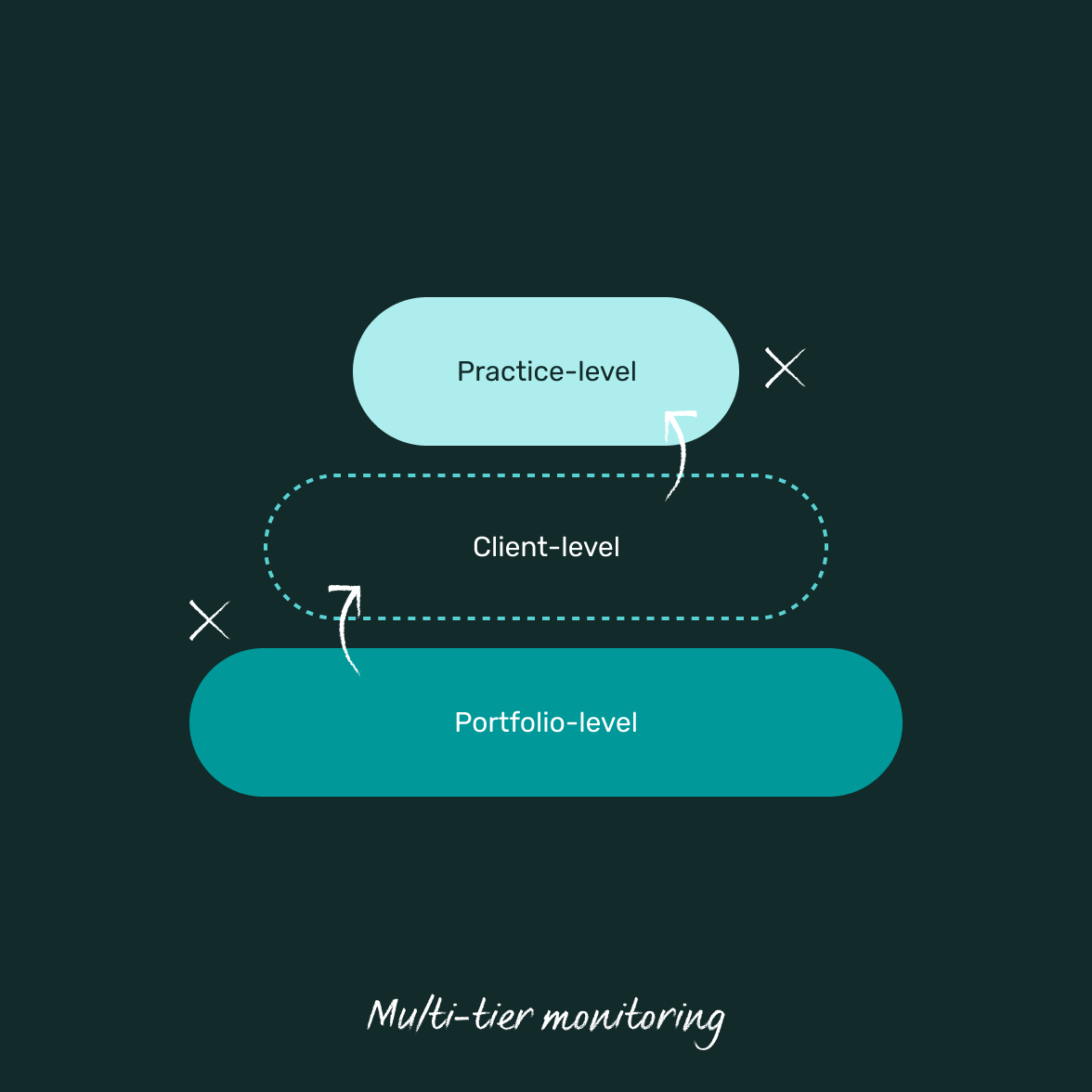
Trustee oversight has to operate at three levels at once. Portfolio-level monitoring tests whether each investment manager is operating inside the mandate the IPS sets — allocations, benchmarks, concentrations, risk-adjusted performance. Client-level monitoring rolls those portfolio reviews up across every portfolio held by a single client and tests overall suitability, because a portfolio that is compliant in isolation can still leave a client over-concentrated, mis-allocated for their needs, or out of step with their investment policy. Practice-level monitoring aggregates every portfolio and every client into a single view across the trust company’s entire book and surfaces systemic exposures, governance gaps and exception patterns the portfolio or client lens cannot see.

Practice-level data is the management information on which the Investment Committee depends: exposures by manager, asset class and jurisdiction, open action points by category and by client, mandate compliance rates across the trust company’s book, outliers that demand committee attention. Monitor, delivered through the Connect platform, produces all three tiers in the same disciplined quarterly cycle. Portfolio reviews feed client reviews; client reviews feed practice reviews; the same data set, surfaced at three levels of granularity, drives every conversation in the room.

trustee-committee-multi-tier-@2x
04

Bring an independent investment voice into the room

An Investment Committee that meets without an independent investment voice cannot properly discharge the duty to take advice. Internal members bring trust company perspective, but that is not the investment context the committee needs at the point of decision. An Enhance Governance Manager is a CISI-qualified investment professional, dedicated to the trust company, who attends each meeting of the Investment Committee, presents the independent monitoring results from Monitor, and supplies the context the committee needs on managers, asset classes and the wider investment environment.

A committee whose investment context comes from the managers whose performance it is meant to evaluate has an independence problem. A committee that depends on a single in-house investment gatekeeper carries concentrated key-person risk. Neither arrangement satisfies the duty to take proper advice. An independent qualified investment voice in the room at every meeting, on the trust company’s side of the table and with no product to sell, addresses both. The committee retains the decision; the Governance Manager ensures it is an informed one.

05

Evidence every decision on the consolidated book of record

The final step ties the first four together. A committee that meets quarterly, runs on practice-level management information and takes minuted decisions still needs somewhere those decisions live and progress between meetings. Without it, the action log drifts, the carry-forward becomes unreliable, and the audit trail collapses. Connect provides the consolidated book of record. It produces the multi-tier reporting that feeds the committee, hosts every Investment Management Agreement and Investment Policy Statement that governs a portfolio, runs the workflow tool through which every action point raised in a Monitor review is tracked from inception to resolution, and maintains the date and user-stamped audit trail that updates automatically as those action points progress.

Together, those elements form the consolidated book of record for the trust company’s investment governance. Practice-level dashboards consolidate the committee’s open and closed action register on demand. Clients that fall outside the formal monitoring regime can be included on Connect as Exceptions, so the book of record is complete across every client the trust company is responsible for, not only those covered by Monitor. That completeness is what turns the four trustee investment duties from a private obligation into a demonstrable, auditable practice — and the documented evidence that the regulator, the board and the auditor expect to see.

trustee-committee-consolidated-@2x

How the five steps map to the four duties

Each step in the playbook discharges a specific duty under the Trustee Act 2000, the legislative framework set out in our companion playbook on trustee investment responsibilities. Read together, the playbook is a practical implementation of those four duties and a way for trustees to evidence that each one has been discharged.

Playbook step Trustee Act 2000 duty How the step delivers
01
Committee
Section 1
Statutory duty of care
A documented committee with clear terms of reference and minuted decisions is the operational expression of the duty of care.
02
IPS
Section 4
Standard investment criteria
A consistent Investment Policy Statement for every client portfolio sets the suitability and diversification parameters every investment is judged against.
03
Monitor
Section 4(2)
Duty to review
Quarterly multi-tier monitoring at portfolio, client and practice level operationalises the duty to review.
04
Governance Manager
Section 5
Duty to take advice
An independent, CISI-qualified investment voice in the room brings the proper context the duty to take advice requires. 
05
Connect
Section 5 
All four duties, evidencing
The consolidated book of record — multi-tier reporting, hosted IMAs and IPS documents, action point workflow and audit trail — turns each duty into a demonstrable, auditable practice.

Each step of the playbook discharges a specific Trustee Act 2000 duty.

Trust company governance: jurisdiction reference

The Trustee Act 2000 framework above is the de facto reference point for trustee investment best practice across the common-law world, but trust companies operate inside their own regulatory regime. The table below sets out the principal regulator and governing instrument for trust companies in twelve leading jurisdictions, together with the common board-level governance expectation in each. The wording differs in each regime. The expectation does not.

Jurisdiction Regulator Primary instrument Trust company governance expectation
Jersey JFSC Code of Practice for Trust Company Business under the Financial Services (Jersey) Law 1998 Effective corporate governance, board-level risk oversight, robust periodic reviews of services to customers.
Guernsey GFSC Fiduciary Rules and Guidance 2020 under the Regulation of Fiduciaries Law 2020 Documented governance, risk management and conduct of business standards for licensed fiduciaries.
Isle of Man IOMFSA Financial Services Rule Book and TCSP Handbook under the Financial Services Act 2008 (Class 5 licence)  Board-level governance, documented risk management and periodic conduct review. 
Switzerland
FINMA
(via Supervisory Organisation)
Federal Act on Financial Institutions (FinIA), in force 1 January 2020 Licensed trustees subject to ongoing prudential supervision; governance, capital adequacy, risk management and compliance evidenced to the SO.
United Kingdom FCA (becoming single professional services supervisor) and HMRC, with SRA for solicitor TCSPs Money Laundering Regulations 2017; FSMA 2000 for FCA-authorised firms Risk-based AML supervision, documented controls, audit trail across client engagements.
Canada OSFI (federal) and provincial regulators Trust and Loan Companies Act (federal), provincial trust company statutes Federal prudential supervision plus extra-provincial registration; documented governance and risk frameworks.
United States OCC (national trust banks) and state banking departments (state trust companies) National Bank Act §27(a) and §92a; state trust company statutes Board-level fiduciary governance, fiduciary audit programme, documented account reviews.
Cayman Islands CIMA (Fiduciary Services Division) Banks and Trust Companies Act; Private Trust Companies Regulations Audited financial statements, on-site inspections, board oversight; CIMA may issue binding rules and statements of guidance.
Bermuda Bermuda Monetary Authority Trusts (Regulation of Trust Business) Act 2001; Trust Code of Practice Licensed undertakings to maintain prudent governance, segregated client funds, evidenced systems and controls.
The Bahamas Central Bank of The Bahamas (Inspector of Banks and Trust Companies) Banks and Trust Companies Regulation Act 2000 Licensing and prudential supervision; on-site examinations and ongoing regulatory reporting.
Singapore MAS Trust Companies Act 2005 and Trust Companies Regulations Licensed trust companies to maintain fit-and-proper standards, financial resources, conduct of business and record-keeping requirements.
Hong Kong Companies Registry Anti-Money Laundering and Counter-Terrorist Financing Ordinance (AMLO), TCSP licensing regime since 1 March 2018 Licensed TCSPs subject to fit-and-proper test, AML/CTF obligations, customer due diligence and record-keeping requirements.

Principal regulators and governance expectations for trust companies in twelve leading jurisdictions.

The bottom line

A trust company’s Investment Committee is a governance forum. It works only when its structure, its inputs, its independence and its evidence trail are all in place: a documented committee with the right composition, every client portfolio reviewed against a consistent IPS, multi-tier monitoring that surfaces what matters at each level, an independent qualified investment voice contributing at every meeting, and every decision evidenced on a consolidated book of record. Monitor delivers the independent monitoring. Connect provides the consolidated book of record. A dedicated Governance Manager brings the independent voice. Together they give the trust company the operating system its Investment Committee needs to satisfy its regulator, its board, and the trustees it represents.

Monitor_Trust Investment Committee_15.06
Resource Category 🟢-2

Playbooks

for trustees

Download this Monitor Playbook for trustees.

monitor-factsheet-cta-mobile

News, Peer Groups and Market Data

Sign-up for the latest news and insights from Enhance, delivered direct to your inbox.

Icon x 4 🟢