Resource Category 🟢-2 Playbooks

Four duties, the risks of getting it wrong, and how trustees can evidence they’ve got it right

For trustees
trustee-duties-cover-@2x
Resource Category 🟢-2

Playbooks

for trustees

This article is a plain-English guide for trustees. It covers the four investment duties that sit at the heart of trustee best practice worldwide — using the Trustee Act 2000 of England and Wales as the framework — the five main consequences of getting it wrong, and how independent portfolio monitoring, delivered through a purpose-built investment governance platform, helps trustees close the gap between what they are expected to do and what they can demonstrably prove they have done to their beneficiaries and regulators.

Being a trustee that’s responsible for an investment portfolio has always been a serious job, but it has become a more scrutinised one. Beneficiaries are better informed, regulators are more active, and investment portfolios are more complicated than they were twenty-five years ago. Yet the core investment responsibilities of a trustee have not fundamentally changed since the Trustee Act 2000 – legislation that paved the way for modern trusteeship around the world. Trustees are expected to act prudently, to keep every portfolio under regular review, and to take proper advice where they need it.

Most trustees already know this. What they find harder is proving, across every client and every portfolio, that they have done it consistently. Investment manager reports are rarely designed to answer the questions a trustee needs answered. Mandate compliance, suitability, independent benchmarking, and action tracking do not appear in most manager statements — and when they do, they are not independent and do not conform to a common review framework. That gap between duty and evidence is where trustee investment risk sits and is the gap that Enhance’s services seek to fill.

Trustee Act 2000: the four trustee investment duties

The Trustee Act 2000 came into force on 1 February 2001 in England and Wales. It modernised trustee investment powers and, crucially, set out a statutory framework for how those powers must be exercised. Four duties sit at its heart, and they have become the de facto reference point for trustee investment best practice across the common-law world.
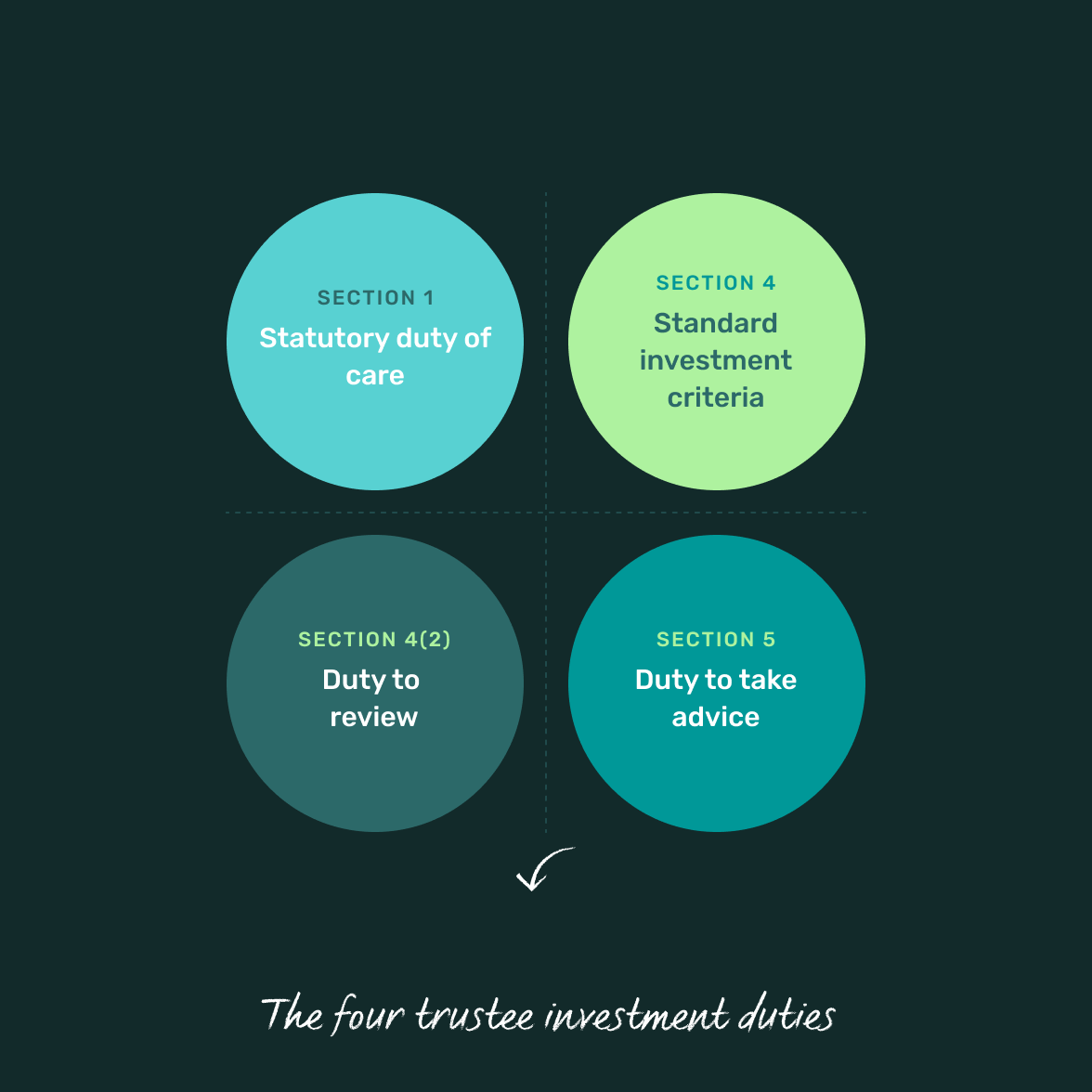
trustee-duties-four-duties-@2x Figure 1
Section 1 Trustee Act 2000

Statutory duty of care

Exercise such care and skill as is reasonable in the circumstances, judged against any professional standing or expertise.

Section 4 Trustee Act 2000

Standard investment criteria

Have regard to the suitability of each investment and the need for diversification across the portfolio.

Section 4(2) Trustee Act 2000

Duty to review

Review investments from time to time and consider whether, having regard to the standard investment criteria, they should be varied.

Section 5 Trustee Act 2000

Duty to take advice

Obtain and consider proper advice before making or reviewing investments, unless it is reasonable in the circumstances not to.

Trustee investment duties are not an abstract concept.

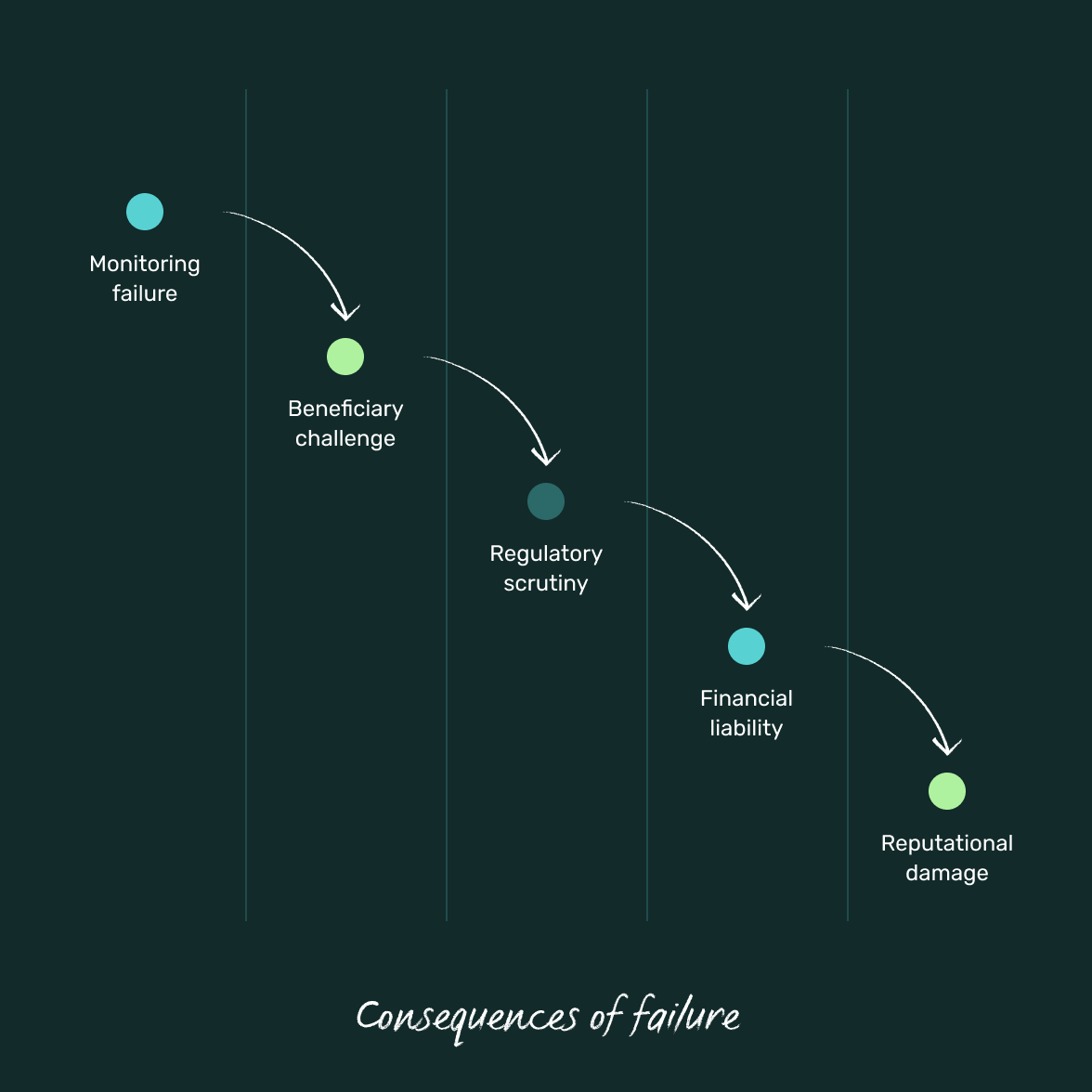
They are enforced by beneficiaries, by the courts and, for regulated professional trustees, by financial services regulators. The consequences of falling short fall into five broad categories, and they compound rather than substitute for one another. A serious breach of fiduciary duty can easily trigger all five at once.

trustee-duties-consequences-of-failure-@2x Figure 2
Consequence What it means for a trustee in practice
Personal financial liability Courts can order a trustee to compensate the trust for the loss caused by a breach. Damages are typically measured as the difference between the actual position of the trust and the position it would have been in had the trustee acted properly — often assessed against a properly constructed comparator portfolio. Professional indemnity insurance may cover part, but not always all, of this exposure.
Restoration of trust assets In addition to monetary damages, a trustee in breach can be required to restore the trust fund to the position it would have been in, including the repayment of any fees taken during the period of breach. Equitable remedies can be broader than common-law damages and are not always capped at foreseeable loss.
Removal and replacement Beneficiaries can ask the court to remove a trustee for serious or persistent breach. Removal carries immediate reputational consequences for a professional trustee and typically triggers a forced transition of the trusteeship to a successor.
Regulatory sanction Professional trustees are regulated in most reputable jurisdictions. The Jersey Financial Services Commission, for example, can impose civil financial penalties, issue public statements, require remediation plans and, in the most serious cases, revoke a trust company business licence. Similar regimes operate in Guernsey, the Isle of Man, the Cayman Islands, Bermuda, Singapore and Hong Kong.
Costs and reputational harm Even where a claim is ultimately unsuccessful, defending a breach of trust action is expensive and disruptive. Professional trustees also face longer-term consequences: the loss of client relationships, harder and more expensive PI insurance renewals, and the reputational impact of a public judgment or regulatory notice.

Two features of this risk profile are worth underlining.

First, damages are typically calibrated to a proper counterfactual rather than to the absolute size of the loss — meaning a trustee can be held liable for the gap between a poorly managed portfolio and a properly managed one, not just for realised losses. Second, the standard of care is higher for professional trustees than for lay trustees. Holding yourself out as a specialist, charging a professional fee, or operating under a regulatory licence all raise the bar against which the court and the regulator will judge your conduct.

The courts do not expect trustees to be market forecasters.

They do expect trustees to have a clear investment strategy, to apply it consistently, to take proper advice, and to keep every portfolio under active review. Trustees who cannot evidence a periodic review process, or who rely uncritically on self-reported data from investment managers, are exposed. Trustees who can produce a clear, independent record of how each portfolio has been monitored against its mandate, what action has been considered and why, are in a materially stronger position.

Monitor and Connect help trustees evidence their investment duties

Enhance was founded in 2005 to deliver investment governance services exclusively to trustees, family offices and charities. Our flagship service, Monitor, is a comprehensive portfolio monitoring service, delivered quarterly through our purpose-built governance platform, Connect. Monitor is designed around the four trustee investment duties in Figure 1 and the five risks in Figure 2. That is not a coincidence — it is what the service is for.

Independent portfolio monitoring, done every quarter

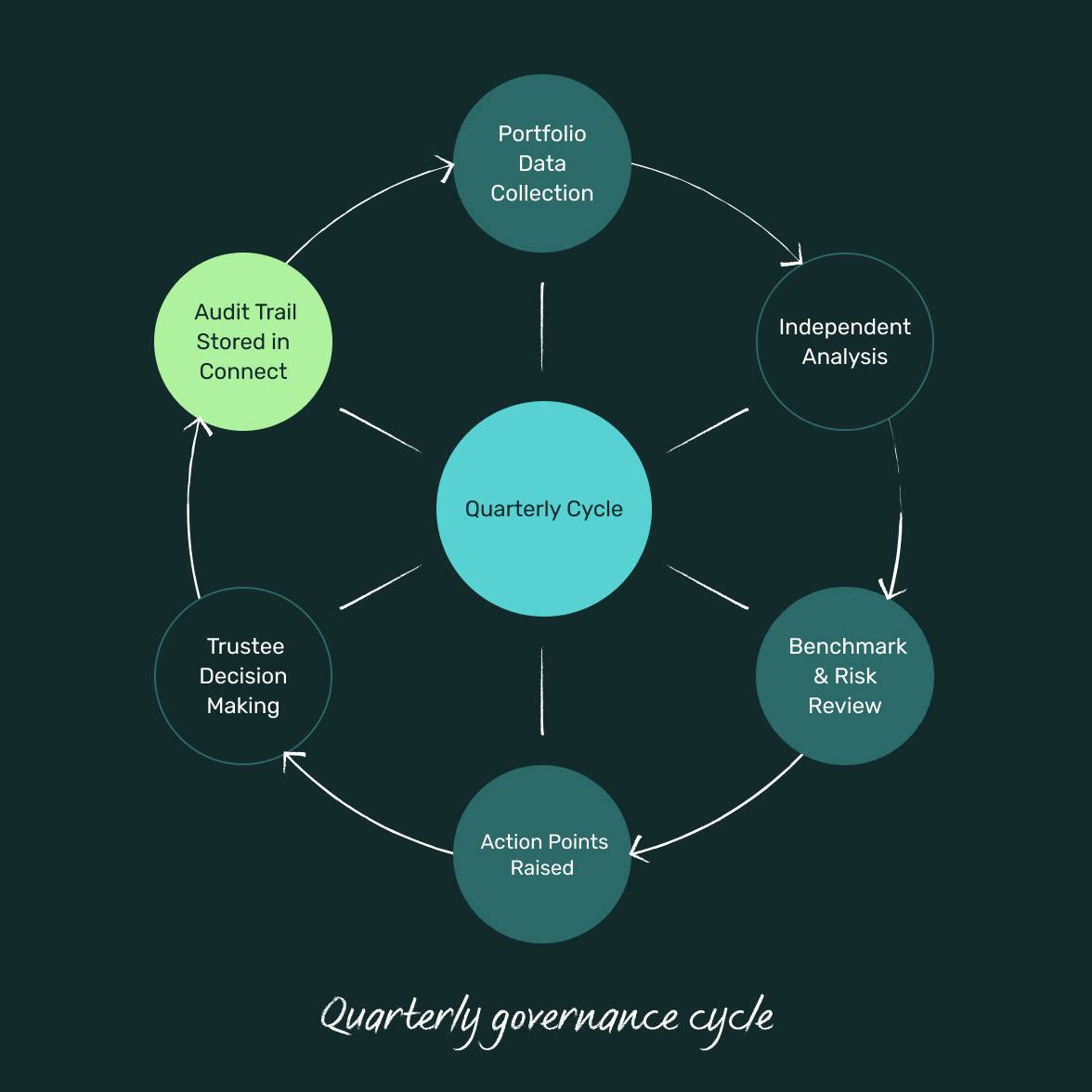
Monitor reviews investment portfolios independently and consistently each quarter. The review framework checks mandate compliance, X-ray allocations, compares returns and risks against a range of independent benchmarks over multiple timeframes, and summarises risk-adjusted performance through a proprietary 1-to-5 Enhance rating. This is not a restatement of the investment manager’s own report. It is an independent assessment, built to answer the questions a trustee needs to answer — is this portfolio suitable, is it diversified, is it performing in line with its investment mandate?

trustee-duties-quarterly-cycle-@2x Figure 3

Actionable insights, not just information

Every Monitor review generates a set of action points in three categories — suitability, technical and administration — so that issues arising from the review are clearly surfaced rather than buried in prose. Action points are tracked from inception to completion inside Connect, giving the trustee a clean audit trail of what was identified, what was considered, what was decided, and when. That audit trail is exactly the evidence a beneficiary, a regulator, or a court would expect a trustee to be able to produce, yet most portfolio monitoring providers overlook this.

Portfolio, client and practice-level oversight

Most trustees are responsible for tens or hundreds of portfolios across multiple clients, jurisdictions and investment managers. Monitor is built to deal with that reality. Portfolio reviews aggregate into client-level reviews covering all investments held for a single client group, and into practice-level reviews that give management and boards global oversight of every portfolio under the trust company’s responsibility. This tiered approach to review reporting provides trustees with relevant information for each level of responsibility and risk they have: portfolio, client and practice.

A governance platform purpose-built for trustees

Connect is the digital hub that brings everything together. Interactive dashboards, flexible reporting templates, workflow tools, bookkeeping data and native integrations with leading trust admin and accounting systems. Connect is included free with the Monitor service and gives trustees — and their boards, their risk and compliance teams, their auditors and their regulators — a single source of truth for the investment data and the review outputs that sit behind every investment governance decision.

How Monitor maps to the four trustee investment duties

Monitor is not a substitute for trustee judgment. It gives trustees the independent information, the structured review process, and the documented record they need to exercise that judgment properly — and to prove they have done so. Mandate compliance and allocation X-rays support the standard investment criteria. A consistent, quarterly review cycle is the duty to review, operationalised. Action points and audit trails evidence that the duty of care is being discharged. Independent benchmarking and practice-level management information give boards, auditors and regulators the assurance they need that the trustee has acted prudently across every portfolio, every client, every quarter.

The bottom line

The Trustee Act 2000 frames it, beneficiaries will test it and, for professional trustees, regulators will enforce it. The conclusion is the same in all three directions. Trustees who take their investment duties seriously need more than good intentions. They need an investment governance framework that puts suitability, diversification, regular review and proper advice at the centre of what they do, every quarter, for every portfolio, across every client. That is what Monitor and Connect are built to deliver.

Monitor_Trust Investment Duties_15.06
Resource Category 🟢-2

Playbooks

for trustees

Download this Monitor Playbook for trustees.

monitor-factsheet-cta-mobile

News, Peer Groups and Market Data

Sign-up for the latest news and insights from Enhance, delivered direct to your inbox.

Icon x 4 🟢